What does the tariff crisis between Colombia and Ecuador reveal about the fragility of intraregional trade in an interconnected geopolitical context?
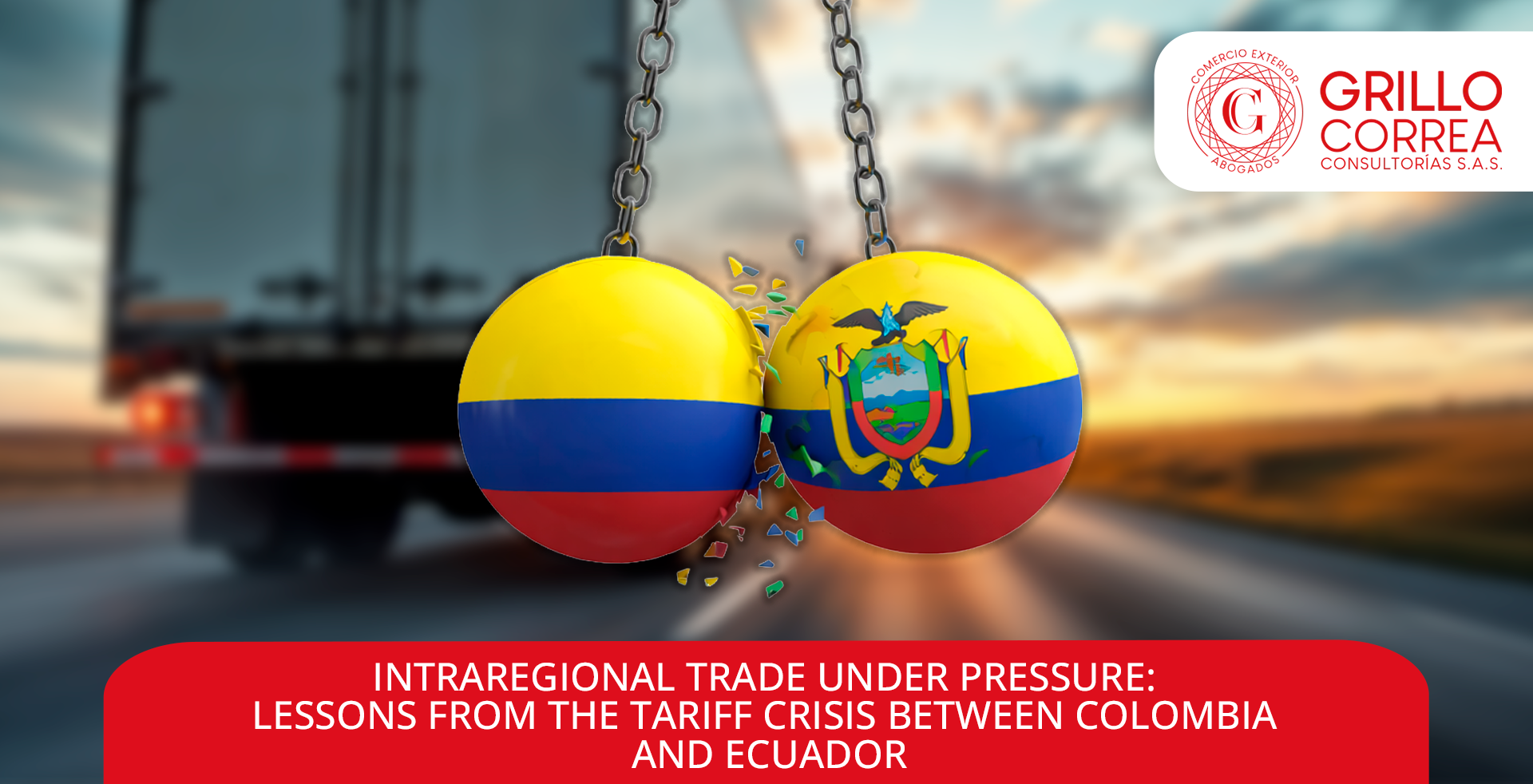
What does the tariff crisis between Colombia and Ecuador reveal about the fragility of intraregional trade in an interconnected geopolitical context? The recent imposition of a 30% tarie on Colombian exports by Ecuador has brought to light a reality that is often underestimated in the region: intraregional trade is deeply sensitive to factors that go well beyond purely economic considerations. Although the measure has been presented as a response to tensions related to border security, its immediate eeects have spilled over into the commercial sphere, disrupting trade flows that for decades have been built under frameworks of regional integration and cooperation. More than an isolated episode, this situation exposes the structural vulnerabilities of trade between neighboring countries in an increasingly interconnected geopolitical environment.
The Colombia–Ecuador Tariff Crisis and Its Immediate Impact
The commercial interdependence between Colombia and Ecuador is reflected both in the scale of bilateral trade and in the composition of these flows. Ecuador currently stands as the sixthlargest destination for Colombian exports, with sales close to US$1.728 billion in 2025, and as the second-largest market for Colombia’s non–mineral and non-energy exports. This relationship is largely sustained by higher value-added goods: between January and November 2025, Colombian exports of electricity exceeded US$133 million, while products such as pharmaceuticals, sugars, and industrial manufactures maintained significant shares within the export basket. For Ecuador, these flows are far from marginal. Colombia ranks as its third-largest supplier of goods, accounting for approximately 7.3% of total imports. This structure highlights a commercial relationship based on productive complementarity and geographic proximity, in which any alteration in market access conditions has direct eeects on strategic sectors in both countries.
Trade Interdependence and Structural Vulnerabilities
Precisely because this relationship rests on significant interdependence, it is particularly vulnerable to factors that transcend the economic domain. In contexts of heightened political and security sensitivity, trade instruments tend to become mechanisms of indirect pressure, even when their original design is not rooted in economic objectives. The current tarie crisis illustrates how concerns related to border security,transnational crime, and bilateral cooperation can be transferred to the realm of foreign trade, altering rules that had operated with relative stability for years. In an increasingly interconnected geopolitical environment, such decisions reflect a broader trend: the use of trade instruments to manage tensions that are, at their core, political and strategic in nature. The result is a scenario in which trade ceases to be a technical and predictable space and becomes conditioned by dynamics of trust, risk perception, and state alignments.
When Geopolitics Overrides Economic Integration
This situation also invites a more institutional examination of regional integration mechanisms, particularly the Andean Community (CAN), to which both Colombia and Ecuador belong. This framework establishes a normative structure aimed at the free movement of goods, the elimination of intracommunity taries, and the existence of formal dispute settlement mechanisms, precisely designed to prevent bilateral disagreements from translating into unilateral trade barriers. Nevertheless, the current tarie crisis reveals a gap between institutional architecture and its eeective application in scenarios marked by high political and security tensions. When conflicts extend beyond the strictly commercial sphere, community mechanisms tend to operate with limitations, whether due to activation timelines, insueicient political coordination, or the prioritization of national agendas. In this context, the CAN faces the challenge of reaeirming its role as a guarantor of commercial stability in an environment where geopolitical pressures undermine the predictability that regional integration seeks to provide.
Lessons for Intraregional Trade in Latin America
The tarie crisis between Colombia and Ecuador thus oeers a lesson that goes beyond the immediate episode and points to broader challenges facing intraregional trade in an interconnected geopolitical context. When bilateral tensions are channeled through trade instruments, their eeects rarely remain confined to a single sector; instead, they extend to logistics chains, business decisions, employment, and ultimately to consumers. Situations such as this underscore the importance of strengthening dialogue and diplomatic mechanisms as priority avenues for managing disagreements between states. In closely linked economies, foreign trade should not become a space of confrontation, but rather an arena for cooperation that contributes to stability, predictability, and shared regional development.